I've had a lot more opportunities to read since I began my pastorate here in Mountain Grove. I've probably already read more in a month than I did all of last year. There's something to be said for such rich intellectual stimulation - in fact, it's been such a difference that it has affected my dreams at night. They've been more vivid, and for only the second time in my life, I had one in which I recognized that I was dreaming and was able to control myself within the dream. In all the reading I've done, though, some authors stand above others.
Eugene Peterson is my hero. Finally, writing for the sake of fidelity to idea and not immediate digestion. Sometimes there is a concept in your head that can only be made incarnate by virtue of one word. I don't want to tell you about what I'm thinking. I want to tell you what I'm thinking - and Peterson apparently agrees. Propinquity. Vacuous. Miasmic. Braggadocio. Ostensible. Blithely. Pedagogue. And that's just a few pages' worth. In one book. He could have made the concepts he talked about accessable to lower thought...but it would have required tiresome explanations that would have mandated blather about the general concept. Blather populated only with words easily understood, whatever that means.
And I'm sure some stupid editor probably highlighted all of his chosen words and told him he needed to find alternatives. Some poetry thankfully escapes the bloodletting of editors' pens. I love reading a fellow lover of language, who rightly regards it as art instead of a bloody cudgel - who uses words as seed in a garden of high rhetoric instead of splinters in the handle of a propagandic hammer. Language is to idea as physical intimacy is to love - the unutterable given utterance in the flesh, expression in action.
If language and rhetoric and semantics aren't passions of yours, that's fine. But don't expect me to goosestep under the banner of this ridiculous notion that we have to mushmouth our speech and cripple our penstrokes for the benefit of people who are unable to divine contextual clues of meaning from a printed text. If you write, instead of writing so the masses can understand, write so that people who actually read can understand - the rest needn't be catered to, because they don't care. They're too busy living their lives vicariously through someone else and allowing themselves to be thought for.
This insipid Basic English movement is distastefully unromantic - rose petals crushed beneath tank treads. It's like shaving your wife's head - much lower maintenance, but at an unacceptable cost to beauty.
Everyone has gnawed their fingernails to the quick over the economy. But a quick overview of history reveals that we've had money before. Several times. And the funny thing is that, despite porcelain promises long shattered, it never solved our problems. Given its company again, we would just as quickly give it to whomever whispered most insistently in our ears that we deserved something it could buy.
Money we've had. It's beauty we need. So for God's sake, put the razor down.
Monday, February 07, 2011
Of Roses and Razors
Monday, August 16, 2010
The Perils of Living Life in 3D
So Kimberly left for a few days to go to meetings, which gave me the run of the house. Thanks to my personal book recommendation engine (aka Julie), I read Michael Crichton's Prey... given my interest in the subject matter, I ended up finishing it in about ten hours over two days.
By that time I was thoroughly informed about the promise and pitfalls of nanotechnology, but sans Internet (I hate you, AT&T!), I was soon looking for something to fiddle with. Then I found Kimberly's stash of toys - namely, her magnetic building set. You know the type - the set with the sticks with magnets at each end and ball bearings for joints. So I start to fiddle around. I begin with basic solids like pyramids and cubes, but of course my mind starts to wander, and I begin to wonder if I could pull off a Buckminsterfullerine molecule.
Buckminsterfullerine molecules, or Buckyballs for short, are a special type of fullerite, a specialized carbon molecule. Buckyballs have the shape of a geodesic dome (or a typical soccer ball, for those uninitiated in architecture), and are mathmatically referred to as a 'truncated icosahedron.' Here's a model:

The principle is fairly basic: a pentagon sprouting five hexagons from its sides, then jamming pentagon points in the resultant notches around the perimeter and surrounding those with hexagons, and so on. So I began to build. I thought I had a home run, and was on my way to a masterpiece that I could bronze and display in the living room. Unfortunately, I ran into some problems. This is as far as ol' Bucky got:
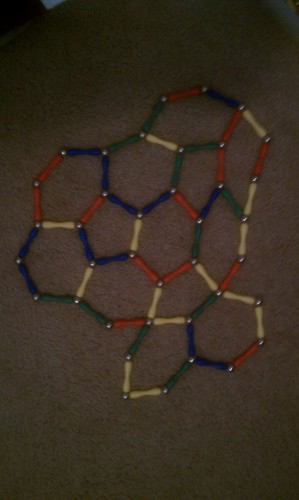
The issue was ultimately weight versus stability. There were a lot of connections, but they were on the outer periphery of the shape I was intending to build. For all their stability in real life, Buckyballs are ultimately hollow all the same - and trying to build one out of Magnetix was a foiled effort. Even if I had three or four people helping me support the sides to make the connections, I think the structure would have collapsed under its own weight.
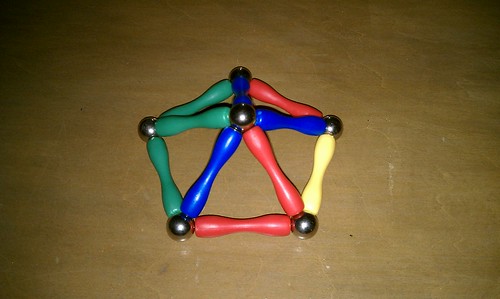
Undeterred, I knew I could engineer something better. I decided to base my new attempt on a pentagon, but decided against marrying a more complex shape to it. Once I build my base pentagon, I figured that I needed more internal stability for whatever I built. So I decided to give the pentagon a centerpoint and connect it to the vertices:
Then I mirrored the shape:
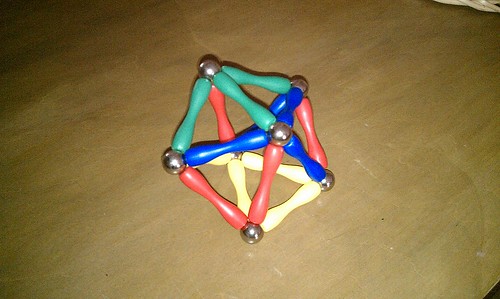
I scratched my head for a bit here, but ultimately went for marrying a simpler shape to this, and built pyramidal points from the faces of each side:
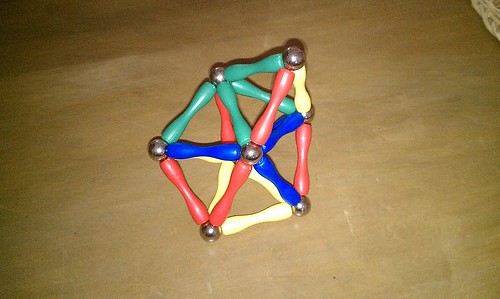
Continuing to do this on each side, I finally ended up with my finished product:
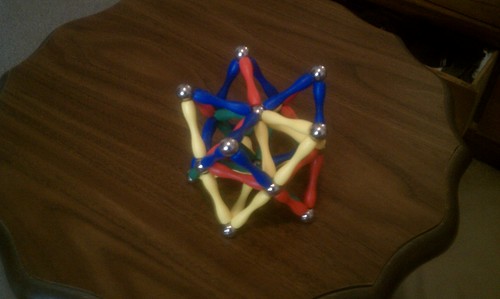
Say hello to my newly constructed triacontagon - a thirty-sided solid (three exposed pyramidal sides per pentagon face times ten such faces). The shape is pleasantly stable - I can actually move it from one place to another without it shattering, if I'm ginger with it. As I looked at it and thought back to my failed attempt at the Buckyball, I realized that this new shape actually had two fewer sides than Bucky, which is a 32-gon (or a tracontakaidigon, if you want to sound impossibly awesome about it).
And so I started thinking about some of the implications of this. Bucky, for all his stability and good press, is a bit of a maintenance pig. He frays at the edges, begins to get distorted the further you get from the origination point, and never quite comes together. This triacontagon, however, was exponentially more stable. The most connections between any two joints in the shape was three - it was tightly constructed around a defined and stable core.
I think this reflects upon our experience sometimes. We tend to engineer our lives around a generally understood 'ideal' that, ironically, nobody really understands. We're told that our lives will harbor meaning and vitality if we construct them like thus and so, emphasizing this and ignoring that. And so we set about our work, tongue poking out of the side of our mouth, slapping the sticks and joints together. So often, though, we find that the whole thing just won't come together or, at best, we need a bunch of other people to prop it up so it's even functional.
I've found that I'm usually better off when I define my own shape. I'd never seen this particular triacontagon before, but then again, the world's never seen a justifreemagon, either. The point is not making your life look like someone else's ideal, but inner connectedness and stability based on centering your life upon something stable. So what does that mean for you? Beats me. You may have more or fewer sides than me, a larger or smaller overall shape, a varying number of connectors and joints.
The one thing we do have in common is the need for an objective sense of truth. Though our shapes vary, you still have to follow some geometric principles - the need for symmetry, for there to be a limited number of connections stemming from one vertex, and so on. Similarly, our lives only function optimally when we follow a course plotted by the One who knows us better than we know ourselves.
Triacontagons, truncated isohedrons, buckminsterfullerenes...your magnet set is too complicated, Kimmy. I need to get a wooden Tinkertoy set for the house.
Wednesday, October 14, 2009
The Death of Shame
I, more than most, am repeatedly reminded of the depravity this generation is laced with. As much as I try to stay away from categorical railings against society at large, I've noticed a pattern in the attitudes and behaviors I see in people - not just the ones I have to mess with, but ones I hear and read about in other places. In my opinion, people aren't engaging in mischief and mayhem because the world is becoming inherently more evil...I think it has to do with the apparent death of shame in our society.
From time immemorial, shame has been the great check and balance that has guided behaviors within societies. In ancient cultures, family was paramount, and to willfully transgress a relationship with God or man meant bringing shame upon your family. This dynamic obviously doesn't come into play much any more. For one, "family" has so many meanings that it means nothing. Not when I see more love in foster homes than within nuclear families sometimes. Not when probably 85% of the calls I work involving 'families' include only one parent.
The single parent aspect is of extreme importance. This is a daily observance for me, and it's more subversive than we give it credit for. Most people, when they think of the concept of divorce within families with children, picture a season of trauma followed by a slow but steady process of healing. This may be true in some cases, but it's not what I'm seeing. More often what I'm seeing looks something like this:
Two people who have what should be obvious incongruities and incompatibilities marry anyway and then, for some reason or another, choose to have children. Perhaps they don't give themselves time to settle into their married lives; maybe they don't see themselves for who they are as a couple; possibly they think that a child will magically fix what is broken within their marriage. Whatever the reason, a dependent entity is created.
At some point after this, the fissures begin to turn into chasms. Perhaps once settled they realize they cannot function connected to the other; maybe something makes them realize who they really are; possibly they look up from changing a diaper or packing a lunchbox and realize that falling in love with their child hasn't caused them to fall in love with their spouse.
And so they destroy their bond of promise and go their separate ways, with great financial and emotional cost. Or, increasingly, because they are already financially strapped they have no choice but to co-exist in a venomous environment, remaining married only because their checkbook holds them at knifepoint. This obviously provides a horrifying paradigm of domestic life for any children pattering around the house.
Either way, from that point forward, their children no longer have a unified entity known as 'parents' but rather separate entities known as 'my mom' and 'my dad.' I'm going to my mom's house; I'll be at my dad's this weekend. And, as a seeming rite of passage, each usually seeks to mollify the trauma by gift-giving or, more insidiously, a softened disposition toward discipline. Thus come the choruses of "Mom always lets me do this" and "Dad gives that to me all the time."
This is a killer on two fronts. First, mom and dad usually don't understand that love does not mean acceptance and tolerance. Love for them seems to be sheltering Junior from the impact of reality. Second, Junior, especially if a teenager, gets a new nuclear weapon called volitional residency. Translation? "Oh, yeah? Well maybe I'll just live with Dad/Mom." The fruits of both sides are awful.
They're what produce the teenagers I'm seeing on the street. The seventeen year old girl with over two thousand dollars in cash in her purse and no clue about how to start a savings account because mom owns a business and "takes care of that stuff." The fifteen year old who didn't just sneak a random beer, but shoplifted a bottle of liquor, drank the whole thing, then stumbled drunk across five lanes of traffic while cars dodged him. The fourteen year old girl who sucked her teeth and rolled her eyes at me when I suggested that she was in the wrong for, you know, stealing things.
I harp on the teenagers. But they're just the poster children. Their parents don't have any shame, either. No shame in lying. No shame in drunkenness. No shame in infidelity. No shame in acid tongues and erupting tempers. Why? Because shame requires that the one shamed be in the minority. To be a sore thumb among their peers, someone to look upon with pity and disdain. The problem today is that lying, drunkenness, infidelity, and anger are, in a wealth of circles, normal behavior.
Many of us think 'normal' relates to some standard, but we forget that normalcy is subjective, and requires only that 51% of a group exhibit the trait. If most people lie, is there really any shame in lying? Who is left to judge? The odd people are suddenly the ones naively telling the truth. They are the ones scorned and laughed at and pressured to conform to the group's collective behavior. And since the human heart yearns to be accepted, this is all too often what ends up happening.
So what's my grand, sweeping solution this time? Well, I guess it's just being weird. If 51% of people are doing something wrong, it suddenly becomes normal, but it doesn't become right. Distill truth from chaos and drink deeply from its depths. Figure out who you are and anchor yourself there - for it would be sorrowful indeed to look back at your life and realize that in trying to live by others' lamplight, you became a thousand things to a thousand people - but you were never you.
In the end, if you whore your integrity out to the whims of others, shame will live.
But you will die.

